Sunday, 5 February 2012

CEM210 - Museums


As I found out in a recent seminar, museums have been around since 530B.C when wealthy people opened their own personal collections.
I have been fortunate enough to be able to visit some amazing museums and galleries including Natural History Museum, Tate Modern, Tate Britain, Science Museum London & Toronto, Museum of Modern Art, Metropolitan Museum of Art, Imperial War Museum and many others. I don’t think I fully appreciate art when I got to a museum unless I know information about an Artist I can study and appreciate a piece of work, but if its just a painting with a name and date next to it I have no connection to the artist and don’t know what their ideas about art.
I agree that every piece shouldn’t have a blurb about them and you need to form your own opinions and assumptions about the piece because art is meant to be subject.
For example modern art can be so thought evoking and creative but can also come across as if the artist created the piece in two minutes with out a thought and its hard to see what the artist thought audience reaction would be.

This brings me to the question who should own culture? For me I think where ever something like a painting is born or produced is where it should belong to, this is what the current Cultural Heritage law states. If say the UK took something fragile from Greece a hundred years ago and they want it back, I think the taken heritage should belong to Greece but if they don’t have the facilities to look after it then England should keep it as a long term long, and vice versa.
In many cases I think artefacts and heritage should be returned to their original owners and then loaned out to other counties to exhibit in museums.

Friday, 3 February 2012

CEM210 - Education Cuts - Music & The Arts


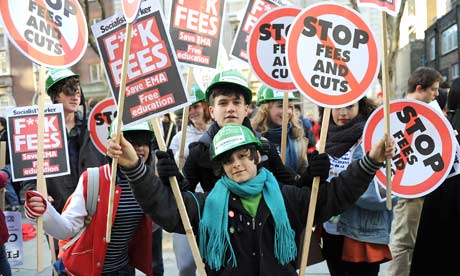
When the Coalition government came into power so did funding cuts all across the government. Education cuts were to be expected but the government minsters tried to reassure us that they were going to cut as little as possible.
When education cuts have to be made they see music and the arts as a nonessential part of education, but I feel this is far from the truth. I realize that English, maths and science are essential, but music and arts is needed for children to do a subject that is more enjoyable while still learning skills at the same time.

There are many studies that show that pupils who learn instruments and participate in extra curricular activities have better grades and higher development.
Looking back on my education some of my strongest and best memories are ones of art and music lessons, I suffered with dyslexia quite badly and had a strong dislike for maths, my school were very good as they tested for dyslexia and arranged learning support for me. I think the music lessons benefited me and other children because I learnt to read music without realizing I was learning which took the pressure off thinking that it was just another subject. Achieving in music and art can be very satisfying because you have a product instead of just grades from a test.

The cuts also affected higher education; the university fees for 2012/2013 have gone up considerable for many institutions which means people will either go and get into more debt when they leave university or not be able to go at all and not get a job they wanted to get because they are not qualified enough.
Many international students come to Britain to study because the education is meant to be some of the best in the world but now with the cuts in the UK, the qualifications are not regarded so highly. This means that now not as many international students will want to come to the UK to study, some institutions require a certain amount of foreign students and some need them for money as they pay a lot to study here.

In conclusion the cuts will be very detrimental to education, I think its unfair for the government to decide that the arts are not as important as other subjects. The individual schools should decide what areas they want to cut because each school has different situations.

http://www.mus.cam.ac.uk/~ic108/MMS/

CEM210 - Cultural Agencies

DCMS
In 1997 New Labour creates Department for Culture, Media and Sport, this means new cultural policies and cultural industries.
"the aim is to improve quality of life for all, through cultural and sporting activities; support the pursuit of excellence; and champion the tourism, creative and leisure
Industries."
The Department has responsibility for Government policy on:
    The Arts
    Sport
    The National Lottery
    Libraries
    Museums
    Galleries
    Export licensing of cultural goods
    Gambling
    Licensing
    Broadcasting
    Creative industries (film and the music industry)
    Press freedom and regulation,
    The built heritage,
    The royal estate
    Tourism

The DCMS are responsible for the 2012 Olympic Games and are currently very busy as its the run-up right now.

Olympics 2012
It will obviously be a massive event and have major impacts on the country especially London. The Olympics is one of the biggest and most important cultural events in the world.
There is so much to consider when hosting the Olympics and so many things that could cause problems for the event. for example terrorism, racism, political feuds, drugs, and violence.
There are 34 different venues across the UK for the 2010 Olympic games. Most people would agree that London is a very suitable host for the Olympics and that we have to resources to put on a very Special Olympics. The 2008 Beijing Olympics was an incredible event with a remarkable opening ceremony that will be hard to top.

CEM210 - We-Think

While researching about technology and culture I found a book in the library called We-Think by Charles Leadbeater, its about the internet being ‘collaborative creativity’ and about encouraging sharing ideas on the web.
Leadbeater thinks that the Internet is such a useful tool for creativity and looks at the positive side of the Internet, the ways it can be used to build creativity, not destroy it with technology.
‘Thanks to the web, millions of people can have their say” Via blog, videos, and websites, there are so many ways people can share their ideas.
People all over the world in different continent can work together, without even meeting.

Charles Leadbeater is a business and political adviser as well as author, writing about social enterprize, the internet, and knowledge driven economy.

Leadbeater talks about the web being a creative outlet where people can “pool their ideas together” he goes on to say “creating mass innovation”. What he is saying makes sense to me and it is already happening with all over the Internet, but he is talking about how everybody imputing to create a mass creative product.

The book talks a lot about Wikipedia, how it has “shared creativity and responsible self goverence” and how public encyclopaedias should be encouraged and used by everyone.
Jimmy Wale the founder says “Wikipedia is: an anarchy because no one is in control of its content, an meritocracy because the best ideas win out, a democracy because people who have been involved in the community for longer have a higher standing in the community, and a monarchy because Jimmy Wale is like the King.
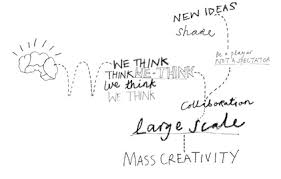
Leadbeater writes that Wikipedia is about anybody and everybody collaborating together to make a resource available for everyone. Leadbeater has a theory that is everybody was to share everything that no one would need to pay to view or hide content. But for this to work everybody would need to share instead of some people sharing and other not. He states that “We are what we share, not what you own”

Some important questions are raised in the book. Like ‘How do we protect what is private’? This is such a an important question because we want to share our work but publishing it on the internet lets anybody access to it, which leads to the question ‘are we safe sharing?’  how do we know who is using or copying our work?  If everybody was sharing everything on the web how ‘would people make people earn a living on the net?’